|
|
|
Integrating Assistive Technology into Affordable Housing and Long-Term Supports for Seniors and Individuals with Disabilities (2004-2007). |
ERI is currently engaged in a three year contract with the State of Oregon Department of Human Services, Office on Seniors and Persons with Disabilities. Under this contract, ERI is assisting DHS to implement a Real Choice Systems Change Grant, Expanding Housing and Supports for Oregonians, from the U.S. Centers for Medicare and Medicaid Services. ERI’s activities focus on the unrealized potential of assistive technology to improve housing supports and quality of life for seniors and persons with disabilities.
There is a gap between availability of innovative technology and effective implementation particularly as it pertains to the needs of low income seniors and people with disabilities. Although lack of funding continues to be an issue, lack of infrastructure capacity represents a significant barrier to integration of assistive technology into affordable housing development and long-term supports. There is a need for mechanisms to promote systematic consideration of consumers’ assistive technology needs as related to housing and long-term supports. There is also a need for innovative ways to educate and connect consumers, technical assistance providers, and property managers who are responsible for long-term supports in housing communities.
The purpose of this project is to:

Oregon Office on Seniors and People with Disabilities
http://egov.oregon.gov/DHS/spwpd/index.shtml

Federal Centers for Medicare and Medicaid Services,
Real Choice Systems Change Grants
http://www.cms.hhs.gov/systemschange
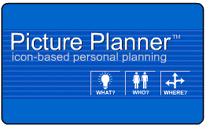 |
Picture Planner™ |
The project that evolved into Picture Planner arose out of several other software development projects designed to help individuals with disabilities live more productive, satisfying, and independent lives.
Picture Planner™ is an icon (picture) based scheduling system that assists individuals with disabilities in planning and viewing activities by individual activity, day, week, or month. Picture Planner uses synthesized speech to provide feedback and aid in accessibility.
Picture Planner is highly customizable -- you may import pictures from any source. Picture Planner also includes a stock library of images to help you get started. You can add new users and easily schedule group activities for multiple users. And you can easily move, copy, and schedule repeating activities, all with an icon-driven software interface.
Picture Planner 2.0 was released commercially in October 2008 through Cognitopia Software LLC. For more information or to obtain a free demonstration copy, go to http://www.cognitopia.com.
For information about Picture Planner in its earlier phase of development, including a way to try it out online, click here: http://www.eugeneresearch.org/picture_planner.
 |
A Model for a Technology-Based Life Skills Curriculum for Secondary Students with Cognitive Disabilities (2001-2005) |
Project Goals: develop and implement a model for a technology -based life skills curriculum for secondary students with significant cognitive disabilities, to evaluate the effectiveness of the model using multiple quantitative and qualitative methods, and to produce applications, materials, and procedures that will enable effective dissemination and replication of the model in a range of settings. There are several key outcomes that will result from this project, including a field-tested comprehensive technology-intensive approach to development of life skills for transition students with cognitive disabilities, and documentation on factors affecting software accessibility, technology use, and implementation across school, home, and community settings.

U.S. Department of Education,
Office of Special Education Programs
Award Number: H324M010064
http://www.ed.gov/about/offices/list/osers/osep/index.html
 |
Information Technology Access for Adults with Cognitive
Disabilities (2001-2004): |
Background and Purpose: Many persons with significant cognitive disabilities are excluded from the benefits of information technology despite the development of new devices and specialized software that support physical access. Commercial software remains largely inaccessible, and the training and technical support needs of these consumers are not addressed. The purpose of this project is to improve software accessibility, training, and user support for the population of persons with significant cognitive disabilities by building on our previous development of accessible life skills software and developing a participatory model for effective consumer training and support.

U.S. Department of Education,
National Institute on Disability
and Rehabilitation Research.
Award Number H133G010162
http://www.ed.gov/about/offices/list/osers/nidrr/index.html
Go back to: Beginning of page

This site is at level-A conformance or above.
Refer to Using our site.